Theatre, born in Greece in the 6th century BC, continued its evolution with the flourishing of comedy, which developed around the middle of the 5th century BC.
It possessed a highly concealed structure, stemming from ancient fertility cults. The fusion of satirical attacks on public figures of the time, daring scatological jokes, and seemingly sacrilegious parodies of the gods formed the basis of its humor.
By the 4th century BCE, comedy had supplanted tragedy as the dominant form. The oldest surviving comedies are those written by Aristophanes.
As a result of the conquests of Alexander III the Great, Greek culture spread, and a new type of comedy emerged around this time, called New Comedy, because literary comedies and philosophical tragedies had become less suitable. The great author of New Comedy was Menander, whose only surviving complete work is The Misanthrope.
In that century, permanent Greek theaters were built of stone, some of which have survived to this day. Theatrical performances took place outdoors, in open-air theaters.
 The building at the center and below consisted of a raised, circular platform for singing and dancing called the orchestra, with the thymele (a circular platform) in the center where the chorus performed; and behind it was the proskenion, or stage, a long, low platform where the performances took place. The audience sat in tiered, semicircular galleries divided into sections called the koilon or theatron. These spaces had a capacity for between fifteen and twenty thousand spectators.
Behind the proskenion was the skene, a large rectangular building, which almost always represented the facade of a palace. Behind the skene were the rooms or dressing rooms for the actors' use.
Puppets also had their place in this nation, where humble, diminutive actors entertained a small group of wealthy and select families. These puppets, known as neuropastas, were operated by dried animal intestines used as strings. They provided domestic entertainment for only a few. The famous puppeteer Photino is known to have traveled throughout the country performing. Generally, the puppets were marionettes.
In ancient Rome, theater did not originate in religious festivals as it did in Greece, although in its early stages performances were linked to religious celebrations. It soon transformed into a form of entertainment due to the increasing number of festivals, with comedy being the most popular. Very short plays, known as farces, were performed; these were comic or farcical works, without a written script, that mocked the vices and customs of the time. They included songs, dialogues, and dances, lacked artistic merit, and were intended for amusement.
Among the types of farces that existed were the Atellan farces, in which the actors wore masks with fixed expressions. Mime, originating in Greece, involved two main characters who wore masks, one dressed in white and the other in rags. This variant was very popular, and women were allowed to perform; expressiveness was achieved through the hands, face, and body. With the advent of the wordless, it gave rise to pantomime.
Comedies began to gain popularity around the 2nd century BC, specifically in 300 BC, achieving greater success than in ancient Greece. It was then that comic playwrights emerged, most notably Plautus and Terence, whose works were adaptations of Greek New Comedy and were based on local intrigues. It became common to take two different plots from Greek comedies and merge them into one, a process known as contaminatio.
The tragedies, for their part, were based on Greek models, without the use of a chorus. There were tragedies set in both Roman and Greek environments; Roman comedy was primarily intended for reading in certain patrician circles.
Theatrical buildings in Rome were constructed of wood for specific festivals and then demolished, a practice that sometimes extended to those made of stone and marble. Theatrical performances also took place in open-air theaters. These theaters underwent stage modifications, such as reducing the space for the orchestra, singing, and dancing, transforming it into a semicircle. The stage elements consisted of three doors at the back, designed to give the impression that the play was taking place in a Roman street, and the scenery was minimal and evocative.
Towards the end of the 2nd century, some spectacles, such as gladiatorial combats, became more popular than theater, although for the Romans they were a form of theater. The fighters reenacted famous battles from history, with a superficial plot, costumes, and sets.
By the first century, public interest in tragedy had waned, so plays were written to be recited or read rather than performed. Among these were the works of Seneca, based on Greek myths, although they tended to emphasize the supernatural aspects, bloody violence, and obsessive passion more characteristic of melodrama.
Around this time, permanent theaters began to be built, the most famous being the Pompeian, founded in 55 BCE. In the city of Rome, there were only three theaters, which, unlike their Greek counterparts, were built on flat terrain. In Roman theaters, the area designated for the chorus, whose function had become insignificant, was reduced to a small semicircle. The orchestra was not used for performances but served as seating for senators and other important figures. Independent buildings were constructed, made possible by the arch as an architectural element.
Puppets were a form of street entertainment, and puppeteers often faced imprisonment or exile if their performances made any political allusions. Called pupa, pupae, or sigilla, Roman puppets were made of clay, wood, or ivory. They represented the masked characters of the Atellan farces.
Theatrical performances in Europe died out with the fall of the Roman Empire in 476 CE. Only popular artists, known as minstrels and troubadours in the medieval world, survived and provided a link of continuity.
Theatrical activity resurfaced in Europe 500 years later, within the Roman Catholic Church, in the form of liturgical drama. Festivals, frequently organized by the Church, had a distinctly pagan and popular character, many of which included theatrical elements, with the aim of expanding its influence.
Between 400 and 1500 CE, church authorities used theater to spread biblical stories and Christian values among the people. Priests created religious dramas called autos sacramentales or mystery plays.
Antiphonal embellishments, known as tropes, were incorporated into the complex musical elements of the Mass in the 9th century. Gradually, the ceremony evolved into a performance in which priests recited and sang the text and played the roles of Jesus, the Virgin Mary, angels, and others. The origins of liturgical drama can be traced back to 925, with a three-verse Easter trope featuring a dialogue between the three Marys and the angels at Christ's tomb.
Liturgical drama developed from various biblical stories performed by altar boys and choirboys. Many thematically related biblical stories were performed as a cycle. These plays were known by various names, including Passion plays, miracle plays, and hymns.
In the beginning, the vestments used for celebrating Mass and the church's architectural features served as scenery. Later, the stage was organized more formally, with the space divided into a mansion (a small stage structure that symbolically represented a specific location) and an auditorium (the area in front of the mansion used by the actors for performing the scene). The mansions were built around the central nave of the church.
Medieval drama did not always depict tension and conflict; its intention was to dramatize the salvation of humanity. The plays were episodic, and their action took place over periods of time spanning thousands of years.
In the 10th century, various church rites allowed for dramatic performances. The Mass itself was not far from being a drama, and some festivities, such as the Palm Sunday processions, were celebrated with theatrical activities.
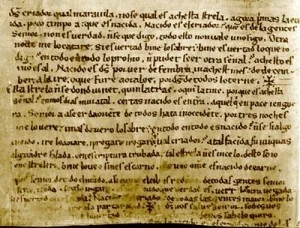
The earliest known Spanish play is called El Auto de los Reyes Magos (The Play of the Three Wise Men), of which only 147 verses survive, dating from the 12th century. In the 13th century, performances inside churches were prohibited because liturgical drama began to incorporate elements of daily life, distancing it from the solemnity of the Mass. It then began to be performed in the inner courtyard outside the church.
During this period, miracle plays emerged, a new form of sacred theater. Based on the lives of saints, their plots frequently centered on scenes from the Old and New Testaments. They incorporated realistic and farcical elements, and their main character was often the Devil or Demon. Among their authors were the Frenchman Jean Bodell and the German Rutebeuf.
Miracles were reenacted during Easter and on other dates of special religious significance. Later, although sponsored by the Church, they were depicted by artisans. They acquired a defined formal structure at the end of the 16th or beginning of the 14th century.
Mystery plays, also called Corpus Christi plays (since they were performed on this feast day), were based on miracles but depicted the life of Christ; this is the form that best characterizes medieval theater. Like miracle plays, they were performed by artisans in town squares on trade fair days. The plot usually began at the very moment of the creation of the world. A complete mystery play sometimes consisted of thirty or forty separate dramas, each dealing with a moment in the life of the protagonist. It could be performed on a portable or static stage.
Then the Church again rejected the theater and, in order not to lose its profits, moved the performances outside the building, so the plays began to be performed in the market squares of the cities or in carts that could be moved from one location to another.
The plays originated in the 18th century and were staged by secular associations called puys. One of their most prominent authors was Adam de Halle. This was a comic genre that satirized the peasant and the merchant.
In the 14th century, theater became independent of liturgical drama, being performed outside churches, especially during the Corpus Christi festival, and evolving into cycles that could include up to 40 plays. These were produced by an entire community over a period of four or five years.
The performances could last from two days to a month. The actors were amateurs and illiterate, so the plays were written in easy-to-memorize rhyming couplets. The plays were full of anachronisms, local references, and commonplaces; the costumes and props were typical of life at the time. Realistic events were staged with the greatest possible authenticity. They had religious content, although they were seen as a form of entertainment.
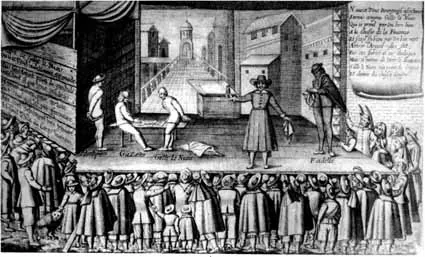
Several basic staging methods were used. In England and Spain, wagons were the most common, essentially a mobile stage. The actors performed on the wagon and on the seating area built for this purpose in the street or on an adjacent platform; a technique used in Spain with slight variations. In France, stages were built simultaneously, with several mansions placed side by side, and a platform erected above them.
A later and much more moderate form of medieval sacred theater was the morality play, which emerged between the 14th and 15th centuries. It was based on allegory. Its protagonist was Sin; other characters—or rather, ideas—represented Avarice, Poverty, and Evil. These plays were performed outside the control of the Church, in the guilds of artisans, an important institution of the Middle Ages. They constituted the precursor to what would eventually become a dramatic genre in Spain: the auto sacramental.