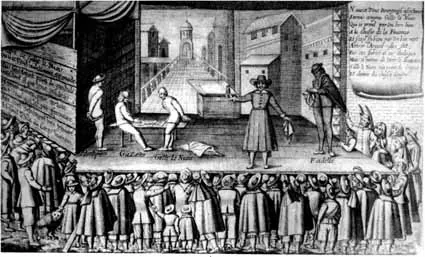
In 15th-century theater, non-religious plays began to emerge, with plots based on traditional tales or humorous anecdotes. Plays with a moral purpose, which used poetry, music, and comedy to teach the people, became popular. In addition, minstrels emerged—small groups of professional performers who worked in inn courtyards and at fairs.
The Corpus Christi plays, also known as mystery plays, since they were performed during that celebration, achieved great renown in Spain around this time, particularly in regions like Aragon and parts of the Levante. Among the most prominent mystery plays was the Mystery Play of Elche. This play commemorates the Assumption of the Virgin Mary and has been performed annually without interruption since the beginning of the last five years.
In the 15th century, miracles and morality plays also enjoyed their moment in the spotlight. The most famous morality play in England dates from the end of the century and is called Everyman. It has a Spanish adaptation known as La disputa del alma y el cuerpo (The Dispute of the Soul and the Body).
Decisive events took place in Europe between the 15th and 16th centuries, which ultimately dismantled the rigid medieval structure, allowing the world to progress. These events led individuals to adopt a new worldview, one that shifted the focus to humanity. This social process, which had far-reaching repercussions in the arts, science, and culture in general, is known as the Renaissance.
Numerous writers, first in Italy and later in other European countries, focused on the theater of the ancient Greeks and Romans. The Renaissance constitutes a period in European history characterized by a renewed interest in the classical Greco-Roman past, and especially in its art. There was an openness to new horizons of knowledge, and consequently, the absolute influence that religion had previously held diminished.
This trend did not occur simultaneously in all European countries, but rather began at different times depending on the location. Nor did it happen suddenly; it was a slow process of change reflecting the evolution of ideas and values at the time. In theater, attempts were made to revive classical drama, but theater itself took on a completely new form, incorporating some aspects of classicism, since classical performances were not widely known.
In Italy, a country that made enormous contributions to theater, the Renaissance flourished. There we find the first examples of Renaissance theater. The first Renaissance plays were written in Latin and later transitioned to the vernacular; their plots were generally based on classical models. They were didactic works intended to be read aloud, and could feature several actors.
The plays achieved no notoriety, since this new theatrical system was not a development of religious forms or popular or dramatic practices, but rather a strictly scholarly procedure. Despite this, some works did achieve considerable success.
Verisimilitude, the appearance of truth, was the most significant Renaissance theatrical concept; it consisted of eliminating the improbable and the irrational in order to emphasize the logical, the ideal, the proper moral order, and a clear sense of decorum. Comedy and tragedy could not be combined; choruses and soliloquies were eliminated. Characters were designed as ideals rather than as individuals with their own particularities.
Among the rigorous rules established by Italian theorists and later adopted by numerous European countries, we can mention that a work could only contain one plot, the action had to take place within a twenty-four-hour period, and in a single location. Adherence to these rules, it was understood, determined the quality of the work.
During this period, learned comedy emerged, accessible only to educated people due to its complex structure. Pastoral drama also flourished, with music playing a crucial role, eventually evolving into a fully sung form that would later give rise to opera. Pastoral drama expressed a rejection of city life and an abstraction of the countryside, emphasizing the supremacy of fantasy.
In terms of architecture, attempts were made to recreate the Roman stage. The first Italian theaters were built in existing spaces, such as palaces and courtyards, which were rectangular in shape. The most significant development for the stage was the discovery of perspective. This technique made it possible to create the illusion of depth or space on a flat surface, which enabled the construction of stages that gave the impression of being real places.
Between each of the five acts of the play, symbolically exuberant scenes called intermezzi began to be presented, which required changes of scenery. During the following centuries, mechanical systems were devised to change them.
During this period, actors' associations were formed to perform farces. These were short plays performed between mystery plays, which eventually became independent of the mystery play and developed into their own genre, featuring popular characters and accessible language.
Puppets had their heyday and their fall. They had an advantage over actors, since the Church allowed a puppet to do or say things that a live actor would not. They took part in religious ceremonies to illustrate the worship. Automata, or mechanical puppet theaters, became popular; these were mounted on large moving platforms and represented animals, angels, and shepherds, among others. The religious scenes unfolded accompanied by organ music and were narrated by a narrator. Soon, puppeteers began to be criticized and attacked.
Actors began to develop, working in the courts; puppeteers were relegated to the roads and small towns, authors did not write for them and the puppets were not repaired due to lack of resources; producing the total decline of puppet theater, although it did not disappear.
Juan del Encina (1469-1529) is considered the precursor of Spanish Renaissance theater. Among his works, dramatic eclogues, are Cristino y Febea, Auto del Repelón, Plácida y Vitoriano, Zambardo y Cardonio, and Filomeno. He wrote and performed short plays in Italian and Spanish court circles, which brought him great renown.
At the end of the 15th century, Spanish theater began its development. It reflected the positive actions of the monarchs and the Catholic Church, and above all, the people's struggle to achieve their freedom. Spanish theater was based on popular and national elements.
Bibliography: Freddy Artiles. The marvelous history of universal theater.