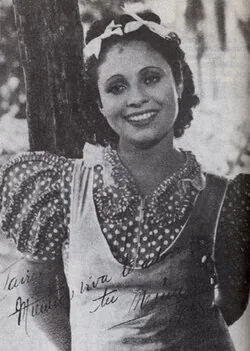
Omara Portuondo Peláez was born on October 29, 1930, in the Cayo Hueso neighborhood of Havana. Her mother came from a wealthy Spanish family, and her father was a baseball player on the Cuban national team. As in any Cuban home, music was always present.
In 1945, Omara followed her sister Haydée by chance into a career as a dancer. She joined the dance troupe of the Tropicana cabaret (Calle 72 No. 4504, Marianao, Havana City); she was part of Las Mulatas de Fuego, danced in the group of choreographer Alberto Alonso, with whom she performed at the Radiocentro theater, in El güije and El solar, and in the dance troupe of Roderico Neyra (Rodney); she formed a dance partnership with Rolando Espinosa.
He debuted on an amateur program on Radio Cadena Habana. In 1947 he joined the group Loquibambia, made up of Frank Emilio, piano; José Antonio Méndez, guitar and singer.
In 1951, she joined Orlando de la Rosa's quartet, replacing Elena Burke. The quartet also included Aurelio Reinoso, Roberto Barceló, and Adalberto del Río. With this group, she toured the United States, performing in New York (Palace Theatre), Philadelphia, Cincinnati, Nevada, and Canada. She was a member of the all-female orchestra Anacaona from 1952 to 1953, with whom she toured Haiti.
In 1953, she was a founding member of the vocal quartet Las D'Aida, directed by Aida Diestro, and composed of Elena Burke, Moraima Secada, Omara, and Haydée Portuondo. With the quartet, Omara performed at cabarets such as La Campana, Tropicana (Calle 72 No. 4504, Marianao, Havana), Sans-Souci, Montmartre, Club 21 (Calle 21 and N, Vedado, Havana), and the Parisién at the Hotel Nacional (Calle O and 21, Vedado, Havana). They toured extensively throughout the Americas and shared the stage with Edith Piaf, Pedro Vargas, Rita Montaner, Bola de Nieve, and Benny Moré. They also served as Nat King Cole's backing vocalists when he performed at the Tropicana Club (Calle 72 No. 4504, Marianao, Havana). They became one of the most important groups in Cuban musical history. She remained a member of it until 1967.
His debut solo album was “Magia negra”, released in 1959. In this album he mixes Cuban music and jazz and includes versions of “That Old Black Magic” and “Caravan” by Duke Ellington.
In 1967, Omara Portuondo began her solo career. She started as a soloist in Joaquín Riviera's show "Diluvio Musical," which took place at the "Parisién" cabaret in the Hotel Nacional (Calle O and 21, Vedado, Havana).
He made his debut as a soloist on an international stage in Poland, where he represented the Areito record label at the request of Gerardo Piloto, director of EGREM (Recording Studios Calle 18 No.103 e/ 1ra y 3ra, Miramar. Havana City).
He recorded with Julio Gutiérrez's orchestra and with the Chilean singer Lucho Gatica. With Los Papines, a Cuban percussion group, he toured Japan. He has represented Cuba at international festivals, maintaining the high standard of Cuban music. He has performed at the Cannes Festival in France; the Golden Orpheus Festival in Bulgaria, where he won first prize for best performance; the Golden Lyre Festival in Bratislava, Czechoslovakia; the Dresden and Schelager Festivals in Germany; the L'Humanité and L'Unitá Festivals in France and Italy, respectively; and the Aguas Dulces Festival in Lima, Peru.
He participated in the Cuban festivals of the Musical Creator, Benny Moré In Memoriam, Ignacio Piñeiro In Memoriam, Popular Music of Varadero, Fiesta de la Música Cubana, as well as in the Adolfo Guzmán and Mi canto a la Ciudad contests.
He toured the United States with the Tropidanza show, alongside Enrique Jorrín's orchestra. He also toured Latin America, visiting Nicaragua, Bolivia, Ecuador, Uruguay, Panama, the Dominican Republic, and Colombia; Algeria in Africa; and Romania, Poland, Russia, Finland, Spain, Italy, Sweden, Norway, the Netherlands, England, and Switzerland in Europe. In the 1970s, he sang with the top brass band, Orquesta Aragón.
Omara made many recordings over the next two decades; but among the best are an album she recorded with Adalberto Álvarez in 1984 and two albums made for the Spanish label “Nubenegra”: “Palabras” and “Desafíos”.
In 1996 he joined the Buena Vista Social Club project, which led to another foray into the international arena and motivated him to increase his recording activity; for the labels EGREM, Nube Negra in Spain and World Circuit in England.
In 2000, they released "Buena Vista Social Club Presents Omara Portuondo," a release that finally placed her expressive voice center stage. On this album, Omara recorded with outstanding Buena Vista musicians such as Rubén González, Orlando "Cachito" López, Manuel "Guajiro" Mirabal, and Jesús Ramos, and also featured guest artists like Elíades Ochoa, Compay Segundo, Manuel Garbán, and Ibrahim Ferrer. The album was met with critical acclaim and led to a world tour for Omara in 2000-2001.
In 2001 she was nominated for a Latin Grammy Award for Buena Vista Social Club presents Omara Portuondo, in the category of best tropical music album.
In 2002, Omara embarked on an extensive solo world tour in North America and Europe. That autumn, she participated in the Japan Jazz Festival, sharing the stage with renowned international artists such as Michael Brecker, Herbie Hancock, John Patitucci, Wayne Shorter, and Danilo Pérez.
In 2003, she participated in summer festivals across Europe, where she delivered a standout performance on the One World Stage at the legendary Glastonbury Festival in England. She also toured Canada and the United States with her band of talented musicians.
She recorded her second solo album, "Flor de Amor," in September 2003 at EGREM Studios (Estudios de Grabaciones Calle 18 No. 103 e/ 1ra y 3ra, Miramar, Havana City), produced by World Circuit. Nick Gold joined Alê Siquiera in production duties. The production team was rounded out by acclaimed engineer Jerry Boys and renowned Cuban musician and arranger Demetrio Muñiz. The album showcased a richer texture and the subtle side of Omara's voice.
Omara undertook successful tours in Europe in 2004, performing over 45 shows in May and June to promote this album. She was accompanied by more than 16 musicians, including Estela Guzmán and Laura Flores from the vocal group Gema 4.
In late 2009, she received the Latin Grammy Award for Best Contemporary Tropical Album for her album Gracias, a collection of traditional melodies, boleros, and jazz. She also began performing the Spanish version of one of the characters in the recent box office hit "The Princess and the Frog" (Tiana and the Frog) with Disney.
Omara Portuondo is one of the most representative figures of Cuban popular song. She has performed almost every genre and style of Cuban music, leaving a record of her talent in an extensive discography. A master of Feeling, she is known to the Cuban people as "The Bride of Feeling."
The life of this outstanding interpreter of Cuban music was captured in the documentary Omara by filmmaker Fernando Pérez.
Omara Portuondo, one of the greatest Cuban singers of all time, possesses astonishing musicality and has been recognized for her contribution to Cuban culture with the Félix Varela Order, First Class, awarded by the Cuban State. She has also received other awards such as the Alejo Carpentier Medal in 1988 and the National Music Prize in 2006.