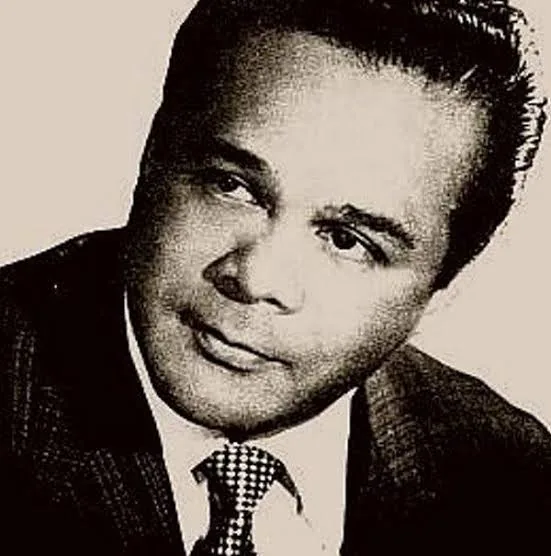
Roberto Faz Monzón was born on September 18, 1914, in the seaside town of Regla, Havana. He came from a humble family of three siblings. His father, Pascual Faz, was a postman and a great music lover, and his mother was Angelita Monzón.
He worked various jobs, including bus driver and bartender.
In 1927, at the age of 13, he was part of a children's septet, Champán Sport, which performed at one of the soft drink factories in Guanabacoa. With them, he won first place in a sonero competition.
At fifteen years old, he received musical guidance from trumpeter Félix Chapotín. Around this time, he joined several popular septets, including Tropical and Cabaña, where he played the timbales, maracas, or double bass, and sang.
In 1930, he joined the Sexteto Ultramar (from Regla), organized by his father, which was very well promoted. In 1932, he was a vocalist with the Copacabana orchestra, later with the Continental orchestra, and with the Charanga Habana. He also sang with the Cosmopolita and Los Hermanos Palau at the famous Sans-Souci cabaret.
From 1936 onwards, Roberto Faz not only worked as a singer, but also brilliantly played percussion instruments such as the bongos, congas, and pailas criollas in the Cosmopolita Orchestra, where he performed on Radio Cadena Habana and CMQ programs with the Lebatard Brothers Band. In 1939, when Tropicana was established (Calle 72 No. 4504, Marianao, Havana City), he became CMQ's exclusive artist.
In 1941, he performed with maestro Osvaldo Estivill's orchestra at the Hotel Nacional (Calle O and 21, Vedado, Havana), singing and playing percussion alongside singer Tito Gómez. Shortly after, he joined the renowned group Kubavana, where he worked with Alberto Ruiz. With this group, he performed at the Zombie Club cabaret and made his first commercial recordings, including the guaracha "No me importas tú" by Mario Recio and the bolero "¿Por qué te vas tan pronto?" by Hugo Cruz, among others.
In 1944, Roberto Espí invited him to join his Conjunto Casino, marking the beginning of his rise to fame as a singer. He eventually became its most significant and popular vocalist. He undertook his first international tours with the group, performing in countries such as Puerto Rico and Venezuela, and shortly thereafter in Tampa, Key West, Panama, and Mexico. In Mexico, he is widely known for his recordings for RCA Victor.
From those bygone days, we remember the recordings of: El viejo verde (1944), El sordo (1945), Comprensión, Flor de fango, Amor de media noche, Realidad y fantasía, Delirio, Quiéreme y verás, Novia mía, Tu mi adoración, and Realidad y fantasía. It must be acknowledged that the feeling movement began to gain popularity with the songs recorded by Faz with the Casino.
In 1948 they recorded for RCA Victor; they dominated radio and television. For a time they performed at the Hotel Saratoga (Paseo del Prado No. 603, Old Havana, Havana City) and on Radio Cadena Habana, Cuba's music station.
In the early 1950s, he performed with the Casino on major Cuban television programs. They made numerous recordings and tours throughout the Caribbean and Mexico.
Faz's voice was powerful, clear, and high-pitched, full of musicality; it became one of the most famous within various genres of Cuban music. At the Casino, he had hits with boleros, guarachas, and filino songs such as "Quiéreme y verás" and "Realidad y fantasía" by Portillo de la Luz; "A romper el coco," a guaracha by Otilio Portal; and "Que se corra la bola," a guaracha by Alberto Ruiz.
Roberto Faz remained with Conjunto Casino until 1955, when he formed his own group with some of the Casino's musicians. He debuted with this group on February 4, 1956, during a dance at the Liceo de Regla (Máximo Gómez No. 153 between Ambron and La Piedra, Regla, Havana). Initially, they considered calling themselves Conjunto Gran Casino, but the producers decided to name it Conjunto Roberto Faz due to his growing popularity.
They performed at the Casino Deportivo, the Tropical Stadium, and the renowned Alí Bar Club cabaret (Dolores and Lucero, Arroyo Naranjo, Havana City), alongside Fernando Álvarez and as a duo with the great Benny Moré. They had major hits such as "Deuda" by Luis Marquetti, which marked a milestone for the group from Regla. Many more hits followed: "Comprensión," "Como vivo en Luyanó," "Cositas de mi Cuba," and "Nací para amarte." During this period, they toured Key West, Tampa, and Panama.
In 1957, he recorded his first full-length album with his group for Panart Records. In 1958, they toured Central and South America with resounding success. In 1961, he recorded the bolero "Comprensión" by Cristóbal Dobal, a huge hit; "Como vivo en Luyanó," a son by René Barrera; and "Cositas que tiene mi Cuba," a son-montuno by Parmenio Salazar.
Roberto Faz's ensemble also left behind a series of recordings of Pérez Prado's Dengue rhythm, which experienced a revival in 1964. We fondly remember the bolero medleys that Faz recorded at a time when the genre wasn't at its peak. They had great success with this style, becoming a sensation at Havana's carnivals.
In 1966 Faz and his Conjunto reached the climate of popular acceptance by recording within the style of the Conjuntos de sones the so-called dengue rhythm.
Roberto Faz's exceptional voice is captured on nearly four hundred recordings, all steeped in the son of the 1930s, which remain a prime example of Cuban popular music to this day. Connoisseurs of Cuban music have hailed him as the only white man to sing son during his era.
Roberto Faz was only 62 years old when he died on April 24, 1966; his passing was considered a great loss for Cuban music.