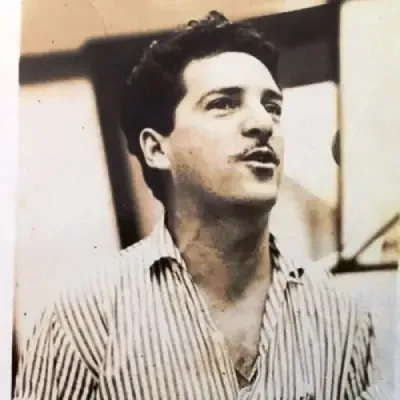
Miguel Ángel Eugenio Zacarías Valdés Valdés was born on September 6, 1912, on Fundición Street in the Belén neighborhood of Havana. His humble family later moved to another Havana neighborhood: the popular Cayo Hueso. His mother, Norberta América Valdés Torres, was originally from Veracruz, Mexico, and his father, Emilio Valdés, was Spanish and worked as a dockworker.
Miguelito studied at a public school called "Emiliano Zapata School" until the sixth grade. At thirteen, he was working as an auto mechanic. Among his aspirations was to be a boxer; he even fought as a welterweight, affiliated with the Cuban boxing federation. He also wanted to be a musician, a profession for which he felt a great passion.
Miguel Valdés learned to play the tres, double bass, guitar, and various percussion instruments. His musical career began in 1927 when he joined the Sexteto Habanero Juvenil, a popular music group. He sang and played different instruments as needed.
Later, he joined the Jóvenes del Cayo sextet as a singer. From that moment on, Miguelito embarked on a long journey in his musical career that would lead him to join numerous musical groups in the country.
Later, he joined the charanga bands of Ismael Díaz, the Charanga Habana, and the Orquesta Gris, directed by Estanislao Servia. Also in 1933, he was a member of María Teresa Vera's Sexteto Occidente.
Thanks to the quality of his voice and the connections he had made, he traveled to Panama, his first trip abroad. There he worked briefly in Lucho Azcárraga's orchestra. Upon his return to Havana, he joined the Hermanos Castro orchestra, led by saxophonist Manolo Castro. He remained with them until 1936, when he and some friends founded the Casino de la Playa Jazz Band.
At Casino de la Playa, Miguelito achieved immense popularity, performing many genres of Cuban music, which allowed him to define his essential style, influenced by the Afro-Cuban rhythms. With this orchestra, he signed a contract with the radio station CMQ, sponsored by the Crusella & Company soap factory. The program became a sensation on national radio.
The repertoire of the “Casino de la Playa” orchestra was of surprising quality, featuring works by Chano Pozo, Arsénio Rodríguez, Osvaldo Farrés, Bienvenido Julián Gutiérrez, among other prestigious Cuban musicians.
In 1939, he left the Casino de la Playa orchestra to try his luck elsewhere. In March 1940, he was hired by the Havana Riverside orchestra, with whom he recorded several songs. That same year, Miguelito Valdés traveled to New Jersey, USA. He had been hired by the owner of the Riviera nightclub to perform with the club's orchestra. This project fell through, so he moved to New York, where he joined Xavier Cugat's orchestra and made his debut at the Waldorf Astoria Hotel, singing as its lead singer.
Miguelito settled in New York, and in 1941 he worked with Machito and his Afro-Cubans, recording again with great success. Around that time, he moved to Mexico, recorded with several Mexican orchestras, and appeared in twelve films. In 1943, he performed in various Havana venues as part of a short stay in Cuba.
In 1945, due to the overwhelming workload, he became so in demand that he lost his voice, becoming practically hoarse. Despite the medical prognosis, he recovered from this ailment and was able to leave to continue fulfilling his numerous commitments.
In 1947, he added his friend Chano Pozo to his band. Miguelito Valdés was one of the most respected and highest-paid Latin singers in New York at that time. In 1951, he made another visit to Cuba and recorded some songs with La Sonora Matancera.
Upon returning to North America during this decade, orchestras like jazz bands were losing popularity, so he decided to record some works with a combo. Also during this period, he traveled to countries such as Mexico, Colombia, and Puerto Rico.
In 1957, he performed at the Tropicana (Calle 72 No. 4504, Marianao, Havana City) alongside singer Lucy Favery. In the 1960s, Channel 47 in New York hired him to participate in several programs. From 1964 onward, he established his residence in Los Angeles, and from there toured various countries.
The famous "Mister Babalú," as the greatest sonero of those years was known, was the main driving force behind Chano Pozo's compositions. His repertoire included various genres such as bolero, son, and guaracha. His style was characterized by his powerful voice and a playful, mischievous take on popular culture. He made 168 recordings with different record labels.
Miguelito Valdés created high-quality works such as the boleros: “Dolor cobarde,” “Loco de amor,” “Letargo,” and “Ya no alumbra tu estrella.” He also composed several conga lines for comparsas, such as “Vienen llegando,” the theme song for the comparsa “Las Jardineras,” and the theme song for the comparsa “Las compositoras.”
He died in 1978 from a heart attack while singing in a performance at a theater in Bogotá, Colombia.