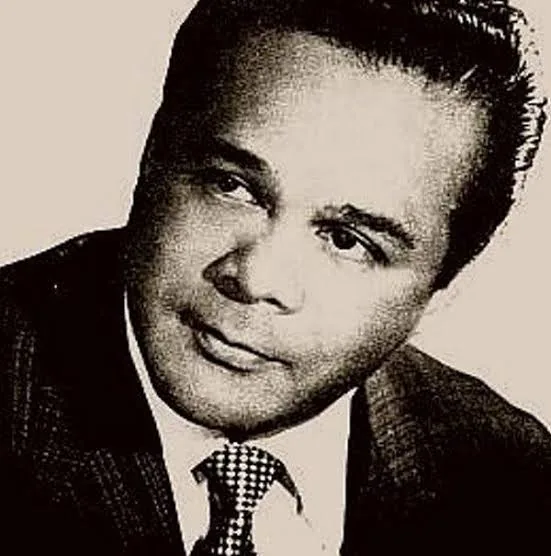
Benito Antonio Fernández Ortiz, Cuban composer and performer, was born in the Tivoli neighborhood of Santiago in 1901. Known to all as Ñico Saquito, he is considered the greatest exponent of Cuban Guaracha music.
At the age of 12, he became a metalworker due to his family's poverty. This allowed him to participate in several sugar harvests before 1959. During the dreaded "downtime," Ñico Saquito would sell rings, matches, stoves, and coffee filters.
According to a legend, when he was young he was hired by baseball teams that visited Santiago de Cuba, to catch the balls that escaped from the field with a sack, hence the fans baptized him as Ñico Saquito.
After several years, he joined Manolo Castillo's Quartet, playing guitar and singing. In 1934, he joined the group Típico Oriental, directed by the talented tres player Guillermo Mozo.
Saquito's success—which brought him widespread recognition—came with his composition "Cuidaíto Compay Gallo" (1936), a highly celebrated work performed by the Matamoros Trio, who recorded the song and popularized it. Other groups added it to their repertoire after hearing some of the verses: "It's better that he speaks, because if he doesn't, it's better that he speaks, because if he doesn't, Rufino the rooster will get me, the parrot said this, because a mistaken rooster confused him with a hen."
In 1937, Ñico Saquito founded the Compay Gallo trio, with which he recorded other popular and infectious pieces, including the Guaracha “Saca la jabita” and the son “Un domingo en el batey”, later chosen by maestro Gonzalo Roig to be performed in the film Romance del Palmar.
Around the 1940s, this charismatic musician gave a new impetus to Cuban Guaracha music with his unique style. Cuban wit and humor were ever-present in his compositions, without ever descending into rudeness or vulgarity.
Several foreign musicians were inspired by the genius of the Cuban composer. They recorded famous songs of the time such as “Camina como Chencha la Gambá”, “Mi cinturita”, and “Me voy para la luna”, while the Mexican trio Los Panchos won over thousands of fans with the song “Silverio, Facundo y la luna”.
Ñico Saquito's most popular song is the one that has remained perpetually in the memory of Cubans: "María Cristina", whose verse says: "María Cristina wants to govern me, and I follow her, I go along with her, because I don't want people to say that María Cristina wants to govern me."
With his music, Saquito earned the applause of audiences in other countries, such as Mexico, the USA, and Venezuela.
His compositions "María Cristina," "Cuidadito, compay gallo," "El jaleo," "Chencha la gambá," and "La negra Leonor" were some of his more than 300 guarachas. His music is featured in the soundtracks of several Latin American films.
In 1979, he recorded an anthology album with the troubadour Eliades Ochoa, while prestigious Cuban musicians such as NG La Banda, Los Van Van and Adalberto Álvarez y su Son continued to perform his creations.
Ñico Saquito died in Havana in 1982.
In his compositions, as Radamés Giro states in his Encyclopedic Dictionary of Music in Cuba: “the Cuban is reflected, his daily life, because his music is a reflection of his idiosyncrasy.”