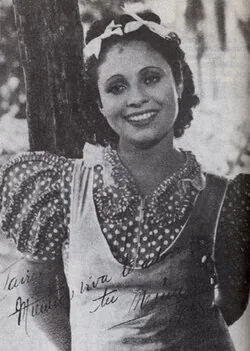
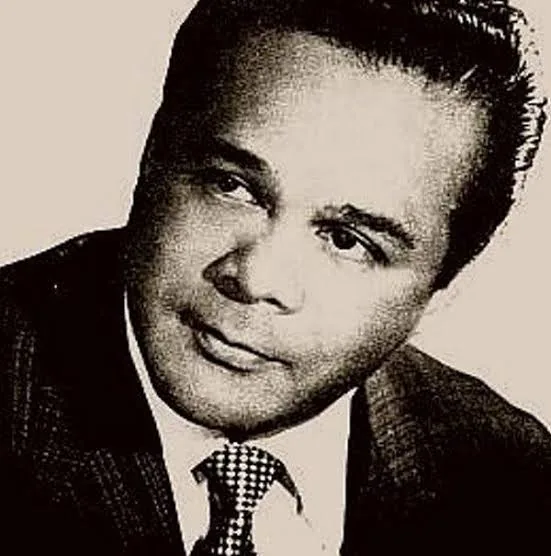
César Portillo de la Luz, Cuban singer and composer; was born in Havana City on October 31, 1922. At the age of 19 he began his artistic life singing accompanied by his guitar.
In the 1940s, alongside leading figures of Cuban music of the time, he pioneered a genre that, with new expressive elements and within the context of Cuban trova music, established a highly realistic dialogue with the public through emotion and the syntactic structure of the bolero. This genre was named Feeling. With this Cuban musical style, his work became significant within the trova scene, performing in nightclubs and renowned cabarets in the capital, such as Pico Blanco at the Hotel St. John (Calle O No. 206, Vedado, Havana).
César Portillo de la Luz composed "Contigo en la distancia" in 1946, marking the beginning of his professional life and the development of a distinctive stylistic personality in his songwriting. He wrote this song at the age of 24, an age when everything in a man's life is expressed with vitality, strength, and passion. Regarding this composition, César Portillo de la Luz stated: "With this song, I learned that the truthfulness of a song's theme transcends mere artistic interest and becomes the exalted expression of an experience that, as a human reality, can endure through generations."
His true professional debut was on the program "Canciones del Mañana" (Songs of Tomorrow) with César and Rebeca (Rebeca was César's guitarist), which aired on radio station Mil Diez. However, his first professional program was on Radio Lavín in 1947; with it, he tried to sell airtime as a troubadour. In 1959, as a continuation of that program, he hosted another on Radio Progreso called "Canciones en la Tarde" (Songs in the Afternoon).
In 1948 he composed "Es nuestra canción," although it didn't achieve the same level of success as "Contigo en la distancia." In 1954 he created "Canto a Rita Montaner," but "Tú, mi delirio" reached the same level of success as "Contigo en la distancia" and was included by Nat King Cole on an album he recorded with Cuban music and music from other Latin American countries.
César Portillo la Luz's songs have been performed by renowned figures throughout history such as Nat King Cole, Lucho Gatica, Pedro Vargas, Fernando Fernández, Luis Mariano, Luis Miguel, Plácido Domingo, Caetano Veloso, Maria Bethania, the London Symphony Orchestra, among others.
His unforgettable compositions have graced diverse stages across Europe, the Americas, and the world. His music has served as a theme for films and has been recorded in countless countries. His songs are distinguished by their highly poetic lyrics, rich harmonic sense, and exquisitely crafted melodies. His immense body of work has enriched the heritage of Cuban song, achieved widespread international acclaim, and established him as a leading singer-songwriter.
Among his most memorable songs are:
• Gray Concert (1946)
• With You in the Distance (1946)
• Bohemian Scene (1946)
• Cuban Night (1946)
• Reality and Fantasy (1946)
• Lost Love (1947)
• It's Our Song (1948)
• Live Again (1949)
• Song to Rita (1954)
• Cha-Cha-Cha of the Pepillas (1954)
• Tasty (1954)
• You, My Delirium (1954)
• Tell Me If It's You (1962)
• Song of a Festival (1963)
• To the New Man (1967)
• Love 67 (1967)
• Song to the Song (1968)
• Everyone's Hour (1968)
• Oh! Valiant Vietnam (1968)
• Love Is That (1970)
• Song About a Story by Onelio (1970)
• Interlude (1972)
• Harangue to Continue a Battle (1973)
• On This Date (1978)
• Song of the Juans (1979)
• Son to the Rhythm (1980)
• Short Song for the Minstrel (1983)
• I Sing, Therefore I Am (1983)
• The Question (1983)
• Monologue in Blue (1983)
• Sampler (1983)
• Mexican Lady (1983)
• True Son (1983)
• Song for That Day (1987)
• Thank You Mrs. M (1995)
• Forever Frank (1998)
• Like a Flower (2003)
César Portillo de la Luz's work has not only been as a composer and performer, but also as a guitar teacher and historian of Cuban song.
Among the awards given to this great Cuban composer and musician are the "Alejo Carpentier" Medal in 1982; the Félix Varela Order in 1996 and the National Music Prize in 2004. On April 15, 2004, the Academy of Arts and Sciences of Music presented him, in its 8th edition, with the Latin Lifetime Achievement Award, in a ceremony held at the Municipal Congress Palace in Madrid, Spain.
“...I believe I have overcome the difficulties I have had to face to do everything I have done. I believe that what I have done has some value. I enjoy the social recognition for my work. I enjoy the affection and appreciation for my work, from which I have managed to make an honest living. Because I live off my work, I haven't had to wait for favors, handouts, gifts, or paternalism, which are not in my nature. I have lived on my own two feet because I have aspired to nothing more than to live off my work, and I do it with pleasure. I earn my bread with joy because I do it doing what I love: music.” César Portillo de la Luz.