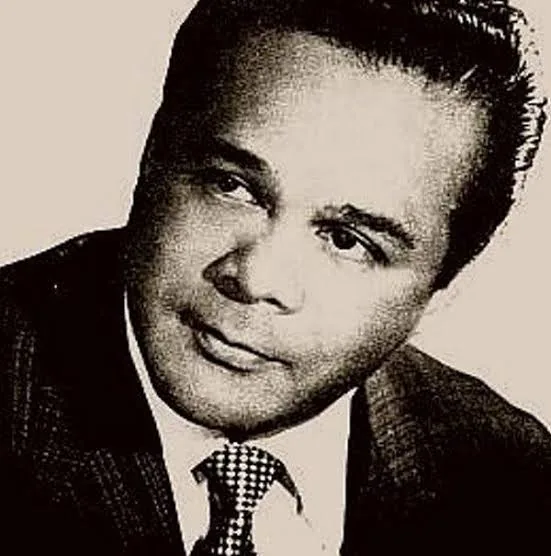
Pascasio Alonso Fajardo, better known as Pacho Alonso, a popular and prestigious Cuban singer, was born in Santiago de Cuba on August 22, 1928. He was the ninth child of a large and humble family: the Cuban Longino Alonso and the Puerto Rican Luisa Fajardo.
From a very young age, he performed with a children's theater company at the old Coliseo Theater in Santiago de Cuba. His debut was on the Cadena Oriental de Radio network under the name Oscar Alonso.
In 1946 he met José Antonio Méndez, who introduced him in the capital of Cuba on the program "Show de Shows" of the well-known Havana radio station Mil Diez, but he returned to Santiago to continue his teacher training studies which he completed at the Normal School of this city.
That same year, Luis Carbonell, a pianist, reciter, and English teacher also from Santiago, was working as the artistic director of several amateur programs on radio station CMKC. Encouraged by Carbonell, Pacho Alonso appeared on a program singing the bolero "Lástima de ti," which earned him one of his first successes as a singer.
In 1948, he was introduced by radio host Gualterio Núñez on the radio program "Revista Popular del Aire" on Cadena Oriental de Radio, accompanied by the orchestras of Pancho Portuondo and Chepín-Chovén. His performances with the Chepín-Chovén orchestra were very successful.
In 1951, when Mariano Mercerón returned from Mexico, he formed a Jazz Band orchestra, with three top-notch singers: Pacho Alonso and Fernando Alvarez, and Mercerón would soon look for Benny Moré in Havana, so in Santiago they called them "the three musketeers".
In 1952, he formed his own group, Pacho Alonso y sus Modernistas. Later, Pacho decided to settle in Havana and change the name of his group to Pacho Alonso y sus Bocucos, overcoming all musical obstacles and making countless recordings independently.
In 1955, he recorded his first record with RCA Victor as the interpreter of the Chachachá de la Reina, a successful piece by the composer Enrique Bonne with the accompaniment of the Mariano Mercerón orchestra.
In 1957, he sang at the Havana carnivals and appeared on television for the CMQ channel on the "Midday Show." That same year, he recorded the songs "Meñoñón (Son Montuno)" and "Serenata de Haití" for GEMA Records. Upon returning to Santiago de Cuba, he continued performing in cabarets and at popular dances, but now with the goal of gaining national recognition from Havana.
At the end of 1958 he reached the peak of popularity with the songs "Enfermo del Alma" and "Dame un chance" by Electo Rosell Chepín.
In 1958, already settled in Havana, Pacho Alonso restructured his group, renaming it Pacho Alonso y sus Bocucos. The following year, he was signed by RCA Victor, with whom he recorded songs such as “Yo no quiero piedra en mi camino” by Enrique Bonne, and a highly popular album featuring the boleros “Imágenes” by Frank Domínguez and “Tú no sospechas” by Martha Valdés. He also recorded the boleros “Niebla del riachuelo” and “La Pachanga” for RCA Victor.
He achieved great popularity during those years and was named Songwriter of 1959 by the newspaper Combate. He performed on the radio stations Radio Progreso CMQ and on Channel 4 of Cuban television.
In 1960, he received the Gold Record from RCA Victor in Medellín, Colombia for his outstanding popularity with La Pachanga.
Her first full-length album emerged in early 1961, Una noche en el Scheherezada con Pacho Alonso, which includes songs such as: Imágenes, Enferma del alma, Tú no sospechas, Calor de nido, Dame un chance, Tú sabes mucho, Dímelo con besos, Se tambalea, Lo mismo da, Son cosas que pasan and No pienses así.
By the late 1950s and early 1960s, the Feeling movement was firmly established. From 1958 to 1961, Pacho's distinctive style solidified within this new approach to composing and performing popular song. He worked closely with other exponents of the genre, such as singers Elena Bourke, Elsa Balmaceda, Orlando Fierro, Gina León, Dandy Crawford, and the duo of René and Nelia, who also made valuable contributions, accompanied by pianists Frank Domínguez, Pepe Delgado, and Frank Emilio, among others. Pacho achieved a unification between composer and performer that brought new emotional elements to Cuban popular song. All of this allowed Pacho to establish himself as one of the greatest exponents of the Bolero.
In April 1961, his second long-playing record, Que me digan feo (Let them call me ugly), recorded for RCA Victor, was released, featuring the hits Juguete (Toy), Soy tu ley (I am your law), Sorpresa de Harina con boniato (Flour and sweet potato surprise), Que de mi comenten (Let them comment on me), Llorar es de hombre (Crying is manly), Tú has vuelto (You have returned), A cualquiera se le muere un tío (Anyone can die of an uncle), Mi parranda (My party), Lola Caturla, Ese amor nunca lo podré olvidar (I will never be able to forget that love), Que me digan feo (Let them call me ugly) and Niebla del riachuelo (Mist of the stream).
One of the most significant moments in Pacho Alonso's musical career came in the mid-1970s when the composer Enrique Bonne, with whom he shared a close friendship, proposed that he incorporate his new rhythm called Pilón. Pacho accepted and popularized this rhythm, which has its origins in the eastern organ and takes its name from the rustic instrument on which Cuban farmers used to grind coffee.
The country's carnivals and international events enjoyed this rhythm that captivated both young and old dancers of Cuban popular music.
In 1967 Pacho decided to form a new group called Pacho Alonso y sus Pachucos, in which he developed his last years of work that continued to show his great versatility and outstanding creativity.
The duo, composed of Enrique Bonne as author and Pacho Alonso as performer, succeeded in making new styles popular, such as the Simalé rhythm and the UPA UPA, although they never achieved the spectacular success of the Pilón rhythm.
During the 1970s, Pacho traveled to several countries in the Americas and Europe, and towards the end of the decade, he added his son Pachito, then very young but already an accomplished pianist and arranger, to his orchestra. Under Pachito's direction, he recorded "Conocí a Pedro El Cojo," "En Guayabero," and "Algo Contigo," as well as many boleros, showcasing his marvelous voice.
Pacho Alonso was invited to the Central American Games in 1970 in Panama. His artistic performances included countries such as France, Africa, Spain, Czechoslovakia, Poland, Romania, Moscow and other cities of the former USSR, Panama, Colombia, Ecuador, among others.
In the last years of his life in Cuba, every cabaret, restaurant, and hotel in Havana featured Pacho Alonso on its bill. For years he entertained at the Santiago de Cuba carnivals, always eliciting rapturous admiration.
Pacho Alonso was a staunch defender of the best and most authentic aspects of Cuban popular music. A creator of rhythms, a researcher of sounds from the very depths of our roots, a forger of a style, a cultivator of a variety of genres, a great bolero singer, a guarachero, and a sonero, a master of the stage. He was also a teacher and an athlete, but above all, he was a great interpretive pillar of all the forms of our folklore.
One year before his sudden death in Havana City on August 28, 1982, the Cuban State had awarded Pacho Alonso the National Culture Medal.