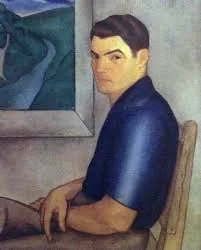
Carlos Enríquez was born in Zulueta, Las Villas, on August 3, 1900; and he died in Havana, on May 2, 1957. After finishing high school, his family decided to pay for his engineering studies in the United States; but once there he moved to Pennsylvania to enroll in the School of Fine Arts in that city, from where he would be expelled due to disagreements with the professors, centered on aesthetic issues.
Upon returning to Cuba in 1925, he did so accompanied by the North American painter Alice Neel, with whom he married shortly afterwards and had two children, Santillana del Mar (after the name of a Spanish town) and Isabel, the first of whom died before her first birthday. By 1930, Carlos Enríquez had abandoned his wife and she, after also being separated from her daughter, attempted suicide several times, for which she had to be hospitalized on more than one occasion.
In 1927 he had taken part in the II Fine Arts Salon and the New Art Exhibition, with good reception from critics, despite the fact that his treatment of the nude would prove controversial for the time. He traveled to the United States for the second time, and he also traveled to Europe for the first time, where he visited France, Spain, Italy and Great Britain, thus coming into contact with dissimilar pictorial universes and artists of the most varied tendencies.
Returning to Cuba, in 1934, he tried to exhibit his works at the Havana Reporters Association, but finally the director of the center refused, arguing that they were immoral, given the rigid conceptions of those years. However, the value of his painting was recognized the following year, with the National Salon prize, awarded to the piece El rey de los campo de Cuba (Manuel García).
In 1938, his work The Abduction of the Mulatas was awarded at the II National Exhibition of Painters and Sculptors. This synthesizes the aesthetic essences of Enríquez: the transparencies, the sense of movement that it communicates, the peculiar sensuality and a deep Cuban identity; although the classic reminiscences regarding the myth of the abduction of Las Sabinas are present. The piece is one of the most important in our heritage and is permanently exhibited in the National Museum of Fine Arts.
Other significant pieces by this artist are Happy Peasants, Las bañistas de la laguna, Dos Ríos and Combate. They can also be cited The Drowned Woman, Isabelita, Marble Woman, Carmen de España, Amor en Pirindingo, Laguna de Banao, Daughters of the Antilles, Atarés 1926, Nancy and Phoebe, Bourdoir and L'Ecuyere, among others. Carlos Enríquez has been one of the main exponents of the Cuban avant-garde and the one who had the greatest awareness of what the act of creation meant in itself, in terms of originality and imagination, beyond academicism and strictly technical conceptions.