Jorge Arche Silva was born in Santo Domingo, Villa Clara, on April 6, 1905; and died in Cádiz, Spain. Since adolescence he began to be interested in the rich universe of the Plastic Arts; In this sense, his first studies were completed at the Villate School of Liberal Arts, guided by Professor Aurelio Melero. Later he enrolled in the San Alejandro Academy, where he completed his academic training and successfully embarked on a career as a painter.
In 1935, at the National Exhibition of Painting and Sculpture sponsored by the Ministry of Education, he presented his works Sailor and La carta. The latter was awarded, so from that moment on it was included in the Permanent Exhibition of the Museum of said Secretariat. This helped boost his career, amid the difficulties derived from a disease he suffered in his childhood, poliomyelitis, the consequences of which forced him to always use crutches and somewhat limited his activities.
Later he successfully participated in the Exhibition of the National University of Cuba, with the works La carta, Paisaje, Mi mujer y yo, Autorretrato, Señor Navarrete, René Portocarrero and Mary, which spanned almost two decades of uninterrupted creative work. In 1941, he also took part in an exhibition organized on the occasion of the Second American Conference of the Corporation of Intellectuals, held at the National Capitol. There he exhibited the pieces René Villaverde, Dr. Emilio Correa, Dr. Fernando Ortiz, Primavera and Domino Players.
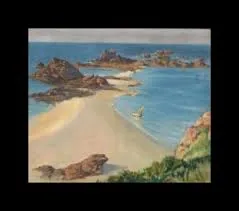
Jorge Arche was a great portraitist, in 1944 he presented 19 pieces of this nature at the Lyceum of Mexico, which were well received by the public and critics; He lived and created there for several years, so this country is also the heir to his legacy. Two years later he presented his work again on the Island, this time the painting Paisaje del Valle, at the III National Exhibition, sponsored by the Ministry of Education.
His work Apóstol José Martí has been reproduced on numerous occasions, others also achieved the recognition of posterity, such as My wife and I, The letter and A girl, which are preserved in the National Museum of Fine Arts. He was a prominent member of the National Institute of Plastic Arts and a prestigious artist for his craft as a draftsman and his careful work with an intimate and emotional range of colors, distinguishable within the set of pieces of the so-called Cuban avant-garde.