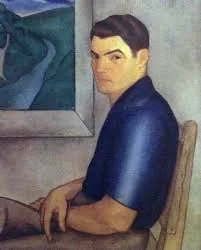
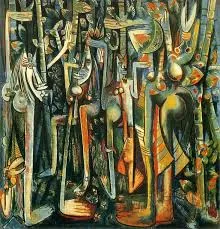
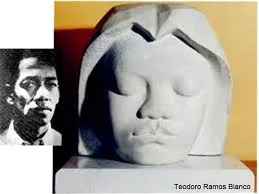
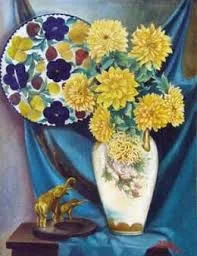
Enrique Caravia y Montenegro was not only a painter, but also an engraver and mosaicist. A prolific artist, he frequently traveled to other latitudes and developed a broad aesthetic worldview, which assimilated various currents and included various media. He was born in Havana, on March 13, 1905; and died in this city, on December 24, 1992, after a long illness.
His first studies were carried out at the Villate school in Havana; Later he was even a teacher at the Félix Varela school and finally enrolled in the famous San Alejandro Academy. In 1923 he exhibited his works at the Lyceum of Havana, the following year he traveled to the United States and there he studied commercial drawing, a discipline that did not have a long tradition at the time but was promising, due to the growing avalanche of advertising that would characterize the 20th century, especially in that country.
Shortly after his return to Cuba, in 1926, he began working as a cartoonist for the Diario de la Marina. However, he was not part of his work team for long, as two years later he won, by competitive examination, a scholarship to study for five years in Europe. He was only 23 years old then; but he was already more than demonstrating his artistic gifts and the sustained effort he was capable of carrying out his work.
Once in Europe, he began studying Coloring, Engraving and Intaglio at the San Fernando Academy in Madrid. Later he traveled to Italy and there he enrolled in courses in Mural Decoration and Fresco Painting at the School of Fine Arts; as well as Engraving, at the Rome Printing School. He later returned to America, but before returning to Cuba he continued his studies of Engraving in Mexico, particularly the techniques of Woodcuts, Etchings and Lithographs, at the School of Free Arts of Mexico.
In Cuba, in 1936, he held the position of Professor of Statuary Drawing at the Elementary School of Plastic Arts attached to San Alejandro, since 1947 he would teach classes at the Higher School. He exhibited his works in cities such as Madrid, Vienna, Munich, Czechoslovakia, the United States and Mexico, in addition to participating in several international events. Likewise, he won prizes in Carnival Poster contests (1937, 1938 and 1945) and the First Prize for decorating the Municipal Palace, around the theme of the Discovery of America.
Among his most important works we can mention the mosaic murals for the Monument to José Martí and that of The History of Culture, located in the lobby of the Museum of Fine Arts. Among his best-known works we can mention Tránsito, Lagarterana embroidering, Mexican Indian, The Painter Marín, Carnival, The Gypsy, Castillo de San Angello (engraving), Mercado de Oaxaca (lithography) and Fuente Fabrecino (etching).