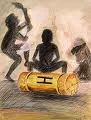
 In the Areíto, the Cuban aborigines used as musical instruments snails, bone flutes, rattles, seashells, the idiophone known as Mayohuacán, the guamo or fotuto and the maracas carved from wood.
The Mayohuacán was the principal instrument for the indigenous people. It was a cylindrical drum without a membrane, featuring grooves in the center, which were struck with two drumsticks. It was sacred to the god Huracán, a deity greatly feared by the indigenous people of Cuba. It was played during almost all of the indigenous songs and was made from the trunks of thick trees. It was a sacred instrument, and it is easy to assume that the natives carved and painted it.
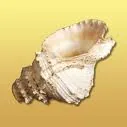 The fotuto, also called guamo, was a wind instrument made from a marine snail shell, which the early inhabitants of Cuba used to communicate and make music. It consists of a large, tube-shaped marine snail shell with the end of the spiral broken off, allowing the player to blow through it, producing loud, resonant sounds.
The maracas of the Cuban aborigines were rattles, mostly made from small, hollowed-out gourds with wooden handles attached, sometimes carved from wood. The maracas used by the shamans (behiques) for religious rites apparently had a single wooden ball inside—in fact, the shaman's maraca was carved from a single piece of wood, including the handle. Those used by aborigine musicians were perhaps more similar to modern maracas, and they likely used two at once, like most contemporary percussionists.