In Europe, mainly in Italy, around the Renaissance there were some women who successfully dedicated themselves to painting, generally daughters or people close to recognized painters, who had a workshop where they could develop their paintings. The trend timidly increased over the years, also in America and Cuba, where already in the 19th century, artists such as Concepción Mercier (1861 - 1935), Rita Matilde de la Pezuela and Juana Borrero herself (1877 - 1896) had displayed a meritorious, although not extensive, work.
Regarding Luisa Fernández Morell, it is known that she was born in Havana in 1897 and lived until after 1952. She stood out as an artist and also as a teacher, she was the owner of a style of luminous lines that she consolidated throughout her academic training, which was not limited to national borders. Her work has the value of reclaiming the feminine perspective on the landscape and the figures she captured, which exerted a certain influence on creators of later periods.
Although he had graduated with a Bachelor of Science, from an early age he expressed his interest in artistic creation and studied at the San Alejandro Academy, where he obtained excellent results. He continued his training in Italy, combining artistic studies with language studies, the latter at the Víctor Manuel III Academy. Later he traveled to the United States and there he perfected the painting techniques he already used, completing the knowledge acquired.
In 1927 she had already returned to Cuba and then began to work as a professor at the San Alejandro Academy, which she did in several chairs, contributing to the comprehensive training of her students. His watercolors were recognized by specialized critics, for which he received, among others, the Color Award from the Ministry of Education and the Círculo de Bellas Artes of Havana.
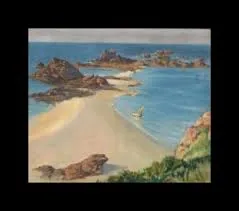
Among the pictorial aspects that he cultivated are watercolor and landscapes, as well as the field of flowers, with their morphological and chromatic varieties. Some works by this author are in the National Museum of Fine Arts and the San Alejandro Academy, as well as other institutions. Particularly, the San Alejandro campus preserves a pleasant memory of this artist, her personality, her creative and teaching work.