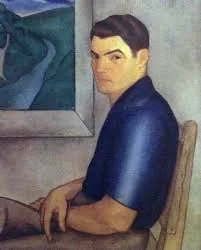
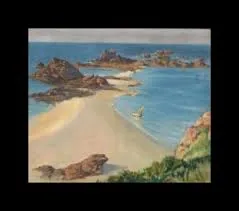
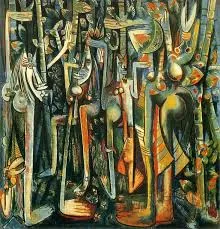
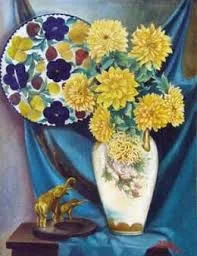
Juana Borrero, who only lived until she was 18 years old, was a young woman of extraordinary talent who did not have time to develop her full creative potential, not only in the plastic arts but also in poetry, where she reached high heights. Daughter of Consuelo Pierra Agüero and Esteban Borrero Echeverría, a prominent doctor, writer and man of culture, she lived a good part of her childhood in an emblematic mansion in Puentes Grandes, which was the venue for famous Havana gatherings, in which Juana herself participated.
The girl's interest in painting and her existential concerns arise precisely in this mansion, under the positive influence of her father and the contact he fostered with nature and the cultural environment of the time. Drawing was one of the essential manifestations that she cultivated, in a desire to reflect everything that surrounded her, with the vehemence typical of youth but already with a quality that many of her contemporaries recognized, including Julián del Casal, with whom she maintained a close relationship. The poet went so far as to say:
"To understand the value of her paintings, it is necessary to contemplate some of them. A short series of lessons received from different masters have been enough for her, enlightened by her genius, to set out to conquer all the secrets of pictorial art. It can be said without any hyperbole that she is in possession of all of them."
Her first painting teacher was Dolores Desvernine, who introduced her to the rudiments of the technique and awakened in her the passion for painting. At the age of nine she began studying at the San Alejandro Academy, where, despite being a woman, she stood out for her exceptional artistic gifts. There she had Luis Mendoza and Antonio Herrera as teachers, and she learned a little more about perspective and the use of color, becoming a young exponent of Cuban plastic art at that time, unfortunately a promise cut short by her early death.
Later she also received several classes from Armando García Menocal, who is said to have been surprised by the young woman's skill in drawing a sketch and considered that he really had nothing new to teach her, since she already had a perfect command of the painting techniques of her time, combined with the imagination and sensitivity of a soul like his, in tune with the beats of her time and her world, which was Cuba above all things.
In the 1890s he traveled to Washington twice with his father, during the first stay he received painting lessons from Professor McDonald for six months, which would complete his academic training. After the outbreak of the war in 1895, her family emigrated, first to Central America and later to Key West, where Juana became seriously ill and died before turning 19. Most of the paintings belong to relatives of the young woman, one of the most talented promises of fine arts and fine letters that the Island had in the turn of the century.