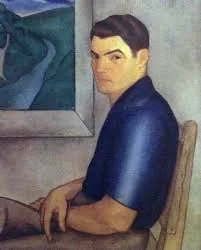
Enrique Crucet was born in Havana, on July 12, 1895. His academic training was quite complete, as he studied painting at the Centro Gallego in Havana (1912), at the Academy of San Alejandro and later at the Royal Academy of San Fernando, Madrid. He also lived for a time in Barcelona, based on his interest in interacting with different currents of real art, beyond the strictly theoretical and technical.
It must be said that Crucet's style was modeled above all at the San Fernando Academy, even though in Cuba he had acquired the necessary mastery over the techniques that he would later use. In this academy he had as teachers prominent figures in the teaching of plastic arts in Spain, such as Cecilio Plá, Joaquín Sorolla, Julio Blanco and Julio Romero de Torres, among others who contributed to shaping his conception of art and of each painting in particular.
In 1918 he returned to Cuba and developed an intense period of creation that would extend approximately until 1920, the year in which he was again in Madrid, where he exhibited these paintings of island motifs, very well received in the old metropolis. He was already a renowned painter who would contribute to internationalizing Cuban culture, still in its infancy, through the value of his work but also the Cubanness of the themes he selected, in terms of content and form.
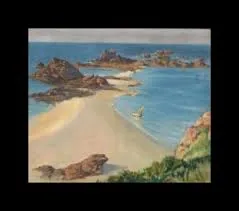
In this sense, the independence exploits of the 19th century were frequent topics of inspiration for Enrique Crucet, both emblematic sites and events and historical figures who took a main part in them. In this regard, the series La Ruta de Martí and Por la ruta de la invasion stand out, both with deep patriotic content. Crucet was also the creator of several still lifes that stand out for their treatment of color and refer to the vernacular in the landscape.
In 1952 he presented an exhibition of his work in New York and two years later he received First Prize at the VII National Salon of Cuba, with the painting Viñales, a region that would arouse the interest of several national artists. A part of his work can be seen in the Bacardi Museum, made up of Sierra de la Gran Piedra, La Gran Piedra, Mañana de sol en la sierra, La palma en la sierra, El Escambray, Belic en Las Coloradas, Niebla en las Cumbres and La sierra desde la Gran Piedra.