The true origins of Cuban painting date back to the period before the conquest, where the aboriginal groups of Guanatahabeyes, Siboneyes and Taínos coexisted or prevailed. Although these did not reach the development of other settlements in Central and South America, and were exterminated in less than a century, they left a mark that was not completely erased, especially through the pictograms found in many caves and pottery pieces with interesting decorations, the latter in the case of the Taínos, who knew ceramics.
With the Spanish colonization and the consequent immigration of peninsulars, pieces by European artists were gradually introduced that would add to the visual scope of later generations, that is, the Creoles. Already in the first century of the conquest there are references to a plastic work whose author was born in Cuban land: the altarpiece or main altar of the Habanera Parish, by Juan Camargo, about whom no other information or pieces are known. In the 17th century, around 1646, another Cuban painter, named Juan de Salas y Argüello, had donated his work "San Miguel Arcángel y Nuestra Purísima Concepción" to the church of the Convent of Santa Clara, of the Poor Clare nuns, in Havana.
In the 18th century, some Creole painters were already known, among them José Nicolás de la Escalera y Domínguez (1734 - 1804), Juan del Río (1748 - 1846) and Vicente Escobar y de Flores (1762 - 1834), who were portrait painters and also continued the tradition of religious imagery. At the same time, some dedicate themselves to the "trade" occasionally, even people known for other reasons, such as the poet Juan Francisco Manzano and the conspirator José Antonio Aponte, both black, in a slave-owning and, consequently, deeply racist society. On the other hand, popular pictorial images proliferated, of unknown author, expressing the exuberance of the tropics and elements of Cuban identity, before the island became a nation.
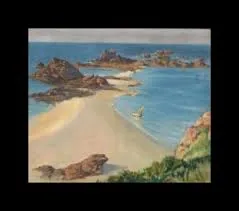
In the 19th century, Cuban painting was fundamentally defined by academicism, which was influenced by the 19th-century historical-social context, with the rise that the Creole bourgeoisie was beginning to take, which had as its model the old European world and its artistic refinement, with a romantic imprint. The founding of the San Alejandro School (originally called the Free School of Drawing and Painting), in 1818, determined that this model was established, where the social autochthonous was sometimes relegated. The natural landscape, the rural areas, were captured but from a sentimental and idyllic perspective, in which Esteban Chartrand y Dubois (1840 - 1883) from Matanzas played a prominent role.
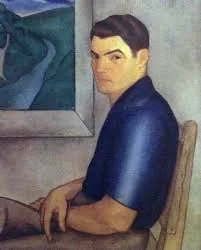
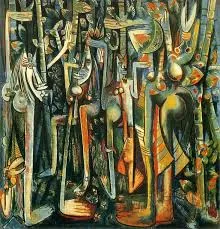
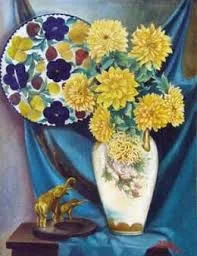
The dawn of the 20th century, particularly the 1920s, brought about an innovative process in Cuban painting. At the same time that what was authentically national began to be expressed, many artists had the possibility of visiting important cultural cities and being nourished by various artistic trends, which broke with the isolation that had prevailed in previous centuries. The San Alejandro School continued to be the training center par excellence for Cuban painters, but it became more flexible in terms of conceptual and aesthetic postulates; For example, in 1937, Eduardo Abela founded the Free Study of Painting and Sculpture there. With the triumph of the Cuban Revolution, in 1959, new transformations took place, not only in creation but in cultural consumption, given the general increase in the level of schooling of the population.. The indigenous and the universal have continued their dialogue since then in Cuban painting, despite the economic vicissitudes, and an increasingly diverse pictorial creation is envisioned, where aesthetic conceptions are not imposed as absolute models.
José Nicolás de la Escalera y Domínguez (1734 - 1804), his pictorial works