Esteban Chartrand y Dubois was born in Matanzas, on October 11, 1840; and he died on January 26, 1883. Despite his short life, he is one of the most significant painters of Cuban art of the time, in addition to having achieved the recognition of his contemporaries and becoming a reference for the wealthy bourgeoisie of the most important cities on the Island.
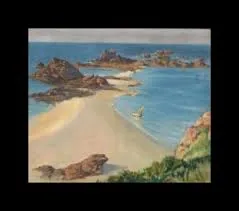
Its notoriety was due, fundamentally, to the beauty of its landscapes, where the fertility and chromatic treatment of the images were quite novel. He used violet, yellow and orange tones, with techniques that denote the influence of French romanticism and other latitudes, but that acquire particular significance in terms of the Cuban environment.
This can even be illustrated with just a few titles: Valle del Yumurí, Estero de Matanzas, Río San Juan, Batey de un cafetal and Un ingenio, all of them pieces that belonged to the collection of Guillermo de Zaldo. Along these same lines is "El Salto de Hanabanilla", which was exhibited at the Sixth Inter-American Conference in 1933, along with the pieces mentioned in the next paragraph.
It must be said that "Dawn", "At Noon", "The Afternoon" and "The Night" constitute the most important canvases of this author, together they make up an interesting mosaic of his artistic vision and the use of the pictorial techniques that he mastered to perfection. These date back to 1873 and were commissioned by the powerful landowner Don Mariano Averhoff y Prieto, owner of the Averhoff sugar mill in Matanzas. They later passed into the hands of Bernardo Gómez Toro, son of Máximo Gómez.
He was also the author of "Paisaje", "El guardian de talanquera" -both from the collection of Emilio Govantes-, as well as "Turbonada de Mediodia". The pieces "The castle of La Chorrera at sunset" and "The Tower of San Lázaro at sunrise" were in the possession of Andrés Terry and Rodríguez Lazanque. One of his best-known pieces, "Boiler House of the Tinguaro Ingenuity", belonged to the collection of Julio Lobo.